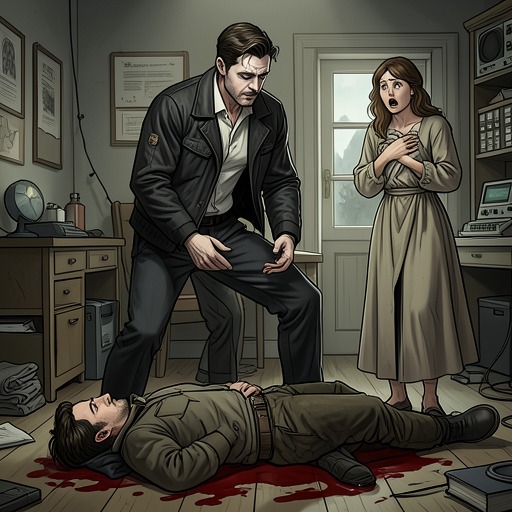
The Justice Board Trial of Shay and Gemma
The Vampire Prince’s BrideThe Justice Board Trial of Shay and Gemma is the formal judgment of Shay and Niqæsh after the struggle over Gemma’s forcibly accelerated pregnancy and the Science Board’s demand that Gemma and her unborn child be surrendered for experimentation. The trial matters because it does more than assign punishment: it tests whether scientific law can recognize coercion as a moral emergency, whether Gemma can speak as a victim rather than merely appear as a subject of research, and whether public outrage can force an institution to confront the violence concealed inside its own procedures.
Causes and Institutional Conflict
The trial grows out of Niqæsh’s order that Shay hand over Gemma and their unborn child for fetal experimentation. Shay refused, attacked fellow scientists, and encouraged his crew to use violence during the rescue. His actions therefore carried two opposing meanings. To the Science Board, he had disobeyed a direct order and violated the laws governing scientific authority. To the public, and to Shay himself, the order represented an intolerable seizure of Gemma’s body and the life developing inside it. His justification was inseparable from the danger he believed obedience would have created: without resistance, he might have lost both Gemma and their child.
Public outrage prevented the matter from becoming a private proceeding, which would have placed Shay in an even more precarious position. Some Science Board members who had stayed silent when Niqæsh demanded the child publicly declared their support for Shay once the case became visible. The shift exposed a central contradiction in the institution: officials could defend procedure while the public forced them to acknowledge the ethical meaning of the procedure’s intended result.
Niqæsh was tried at the same time and suspended from the Science Board. Petitions circulated demanding that her authority be removed entirely. Her punishment made the case broader than Shay’s disobedience. The proceedings examined not only whether Shay had broken rules, but also whether Niqæsh had abused scientific power by treating Gemma’s pregnancy and unborn child as research material without meaningful consent.
The Trial and the Two Defenses
Shay and Gemma were under house arrest while the trial was pending. Two months had already passed since the explosive acceleration of Gemma’s pregnancy was stopped, but the medical damage could not yet be fully measured. Shay scanned her enlarged belly and back and could confirm only that the baby appeared healthy. He warned that the full extent of the harm would remain unknown until after birth, when more powerful scans could be performed. The uncertainty preserved the trial’s central stakes: the experiment had ended, but its consequences were still unfolding inside Gemma’s body.
Shay was required to give the formal justification for his actions. Under ordinary procedure, a justification would be heard only after four months of evidence had been delivered to the Justice Board. Because Gemma could enter labor at any time, the Board made an exception and allowed him to speak first. The altered timetable reveals how pregnancy transformed an administrative case into an urgent contest against time. Shay did not want to defend himself after the child was born; he wanted the Board to hear why he acted before the birth made the consequences irreversible.
Gemma insisted on speaking as well. Shay initially argued that she was not strong enough, but she rejected the idea that physical weakness should remove her from the proceedings. She prepared her speech as a lawyer who had spent two months studying Stlozyn law, and she demanded the opportunity to explain in her own words what imprisonment and experimentation had felt like. Her participation changed the structure of the trial. She was not simply evidence of Shay’s motives or the site of Niqæsh’s alleged misconduct; she became a legal witness to the lived reality that technical language could otherwise conceal.
Gemma’s testimony was delivered from a hover chair, which allowed her to move in every direction, after Shay had given his justification. The narration presents her speech as less conventionally inspiring than a human courtroom address might be because Stlozyn culture privileges logic and regards emotion as close to the root of evil. That contrast gives her testimony its force. She does not win by abandoning the society’s intellectual standards; she makes an experience of confinement legible within a system that habitually discounts feeling.
Judgment and Consequences
The Justice Board found Shay’s justification worthy of his actions, even while acknowledging that he had violated direct orders and helped provoke violence against scientists. He was ordered to provide remuneration to crew members who had broken laws while following him. The sentence therefore recognized both sides of his conduct: the rescue had ethical legitimacy, but the method still produced legal liabilities for everyone involved.
After the sentence, Shay was reinstated as Science Alpha on his ship. His restoration was not unconditional praise. He was warned not to become so emotional in the future, a reprimand that preserves the cultural hierarchy between rational control and passionate action. Yet the warning also confirms that emotion had not invalidated his judgment. The Board accepted the substance of his defense while attempting to discipline the form in which he had acted.
Niqæsh suffered the more decisive institutional reversal. She was suspended, stripped of her position, and ultimately lost her research buildings. Her personal wealth was assigned to a fund for ethical research. The redistribution transformed the aftermath from a private punishment into a public repair effort: the resources associated with coercive research were redirected toward preventing similar abuses.
Pregnancy, Damage, and Aftermath
The trial could not restore the pregnancy Gemma should have experienced. Although the acceleration had been stopped and Shay believed the child was healthy, Gemma remained in pain, with an aching back and weakened legs. She was furious that Wynon had stolen half of her pregnancy from her, and she never truly felt the baby kicking. This aftermath gives the legal victory a physical limit. Recognition by the Board did not return the time, sensations, or bodily control taken from her.
The case also remained open in a medical sense. Shay could not know the full extent of the experiment’s damage until after the birth. The child’s apparent health was reassuring but not conclusive, and the uncertainty kept the consequences of Niqæsh’s actions active beyond the courtroom. The verdict ended the immediate institutional dispute while leaving Gemma and Shay to confront the delayed results of scientific interference.
The final institutional consequence was an offer to Shay. After Niqæsh was removed, a Science Board representative offered him her vacant position on the Board. The offer marked a dramatic change in his status: the scientist who had been placed under arrest for defiance was invited to help govern the institution whose authority he had challenged. It also placed him inside the structure he had resisted, suggesting that reform would not occur only through punishment but through the redistribution of decision-making power.
Narrative Significance
The trial’s decisive value shift runs from criminal jeopardy toward qualified vindication. Shay begins under house arrest, facing discipline for disobedience and violence; he ends reinstated as Science Alpha and considered justified, though still censured for emotional excess. Gemma begins as the person whose body and pregnancy have been controlled by others; she ends as an articulate participant whose testimony helps define the ethical meaning of the case.
The proceedings also expose the limits of law when law is built around institutional obedience. Niqæsh’s demand was authorized by scientific hierarchy, but the trial makes clear that authorization alone cannot settle whether an act is just. Shay’s rescue violates procedure because procedure has failed to protect Gemma. Gemma’s speech then supplies what laboratory records and legal evidence cannot: an account of imprisonment as an experience of bodily dispossession.
The event therefore joins personal survival to institutional reform. Shay and Gemma protect their family, Niqæsh loses power, ethical research receives her seized resources, and Shay is drawn into the Science Board as a possible corrective from within. The trial does not erase the violence that preceded it, but it changes who is allowed to define that violence and what consequences the scientific order must bear.